

Backgammon Rules
How to play Backgammon?
This page explains the modern backgammon rules in a simple, step-by-step format. Whether you are learning the game for the first time or need a refresher, this guide covers the essentials you need to start playing with confidence, both casually and in club settings.
What you’ll learn: board setup and direction of play, the objective, rolling and moving (including doubles), hitting and entering from the bar, blocking and prime building, bearing off, and a brief introduction to the doubling cube.
What Equipment You Need To Play?
Backgammon is played with a Backgammon Set containing the following accessories:
- Backgammon board
- 15 unique coloured checkers for each player; 30 in total
- One pair of Backgammon Precision Dice for each player
- One shared Doubling Cube is used to keep track of the game’s stakes
- Backgammon Dice Cups for shaking and rolling the dice
The layout of the Backgammon Board
The backgammon board is divided into two halves by a raised central bar. Each half contains two quadrants, and every quadrant has six long, narrow triangles called points. In total, the board has 24 points (sometimes referred to as pips). All are mandatory according to the backgammon rules.
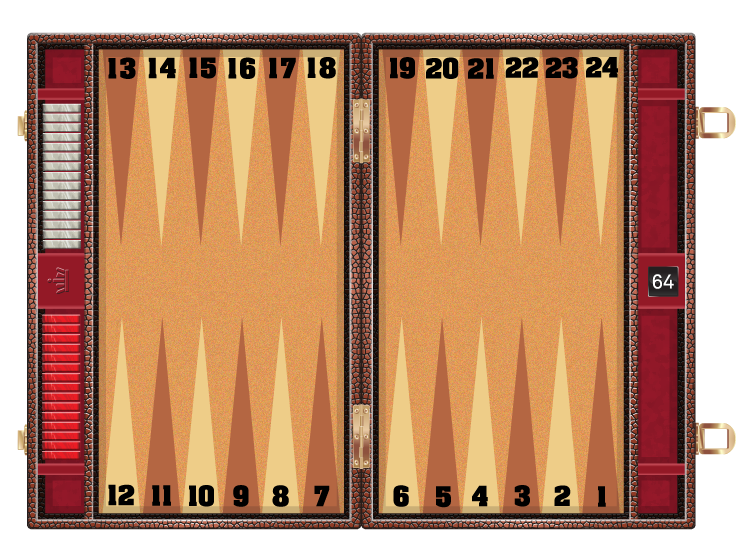
The four quadrants of the backgammon board are defined as follows:
- Red’s Home Board: points 1–6
- Red’s Outer Board: points 7–12
- Opponent’s Outer Board: points 13–18
- Opponent’s Home Board: points 19–24
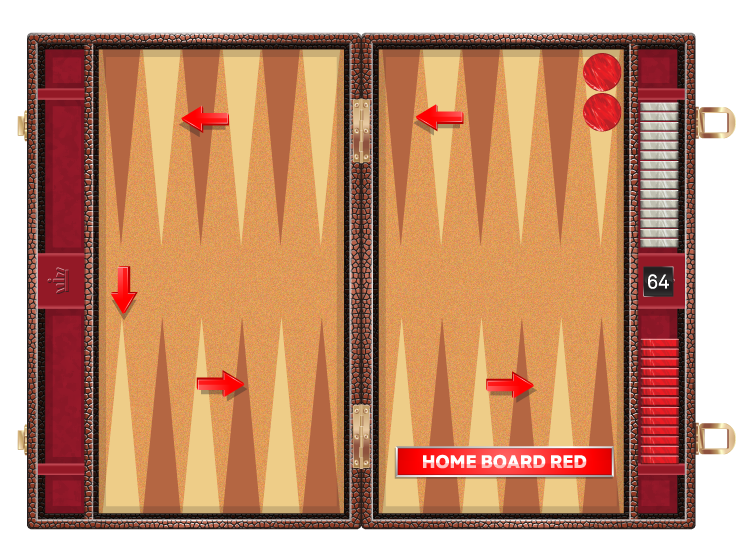
Backgammon Board Set Up
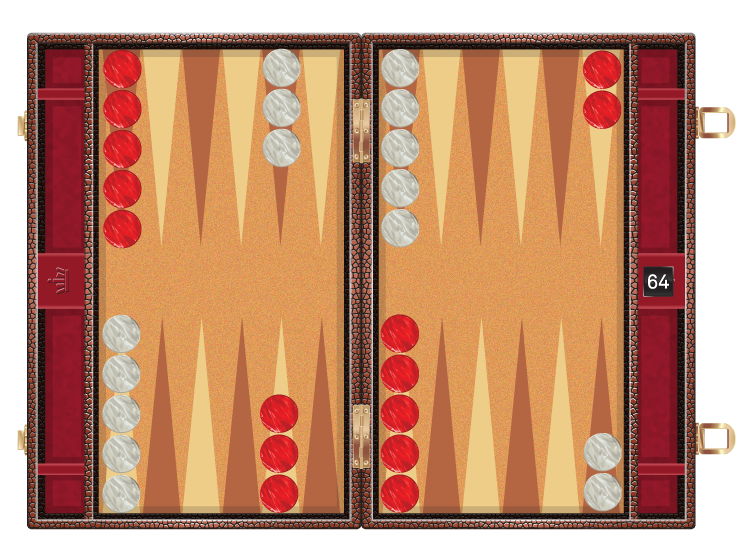
Each player begins with 15 checkers arranged as follows:
- 2 checkers on the 24-point
- 5 checkers on the 13-point
- 3 checkers on the 8-point
- 5 checkers on the 6-point
Players sit opposite each other with the board placed between them. The setup is mirrored so that each side is a reflection of the other. The bar running down the middle separates the home boards from the outer boards.
For a more detailed explanation, including memory tricks to help you set up correctly every time, see our dedicated guide on How to Set Up a Backgammon Board
The Objective Of The Game
The aim of backgammon is simple: move all 15 of your checkers into your home board and then bear them off before your opponent does.
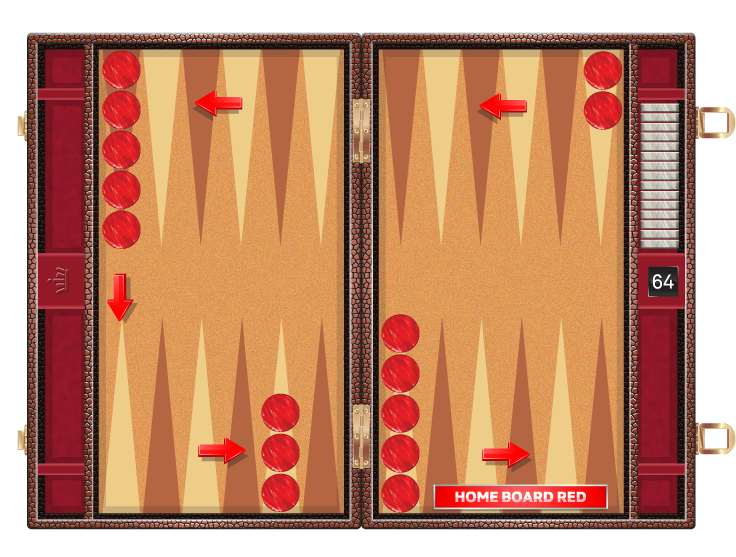
Checkers always move forward around the board in a set direction. Once every checker you own has reached your home board, you can begin bearing off, removing them from the board. The winner is the first player to bear off all 15 checkers.
Determine Who Will Start
To determine who begins, each player rolls one die. If the numbers are the same, both players roll again until the results differ. The player with the higher number makes the first move, using both dice from the initial roll as their opening move. After this first turn, play continues in the usual way, with the opponent rolling two dice to make their move.
Rules for Moving Checkers
The roll of the dice determines how many pips (points) a player may move their checkers. Checkers always move forward around the board and never backward.
General Movement Rules
- A checker may only be moved to an open point, meaning a point not occupied by two or more of the opponent’s checkers.
- Each die represents a separate move. For example, a roll of 3 and 5 may be used to move one checker 3 spaces and another 5 spaces, or the same checker a total of 8 spaces, provided both the intermediate and destination points are open.
- Doubles (e.g., rolling 3–3) allow the player to play the numbers twice, giving four moves of 3 in this example.
Obligation to Play
- Players must use both numbers rolled if it is legally possible. In the case of doubles, all four numbers must be played if possible.
- If only one number can be played, the player must play that number.
- If only one of the two numbers can be played, the player must play the higher number.
- A turn ends when neither number can be played legally.
Landing on a Point
On each turn, a player rolls two dice and must move according to the numbers rolled. Even when using both dice for a single checker, the move must touch down on two separate points, the intermediate point and the final destination.
A checker may land on:
- An open point (empty).
- A friendly point occupied by one or more of the player’s own checkers (there is no limit; all 15 checkers could, in theory, stack on a single point).
- A blot (a point occupied by a single opposing checker), in which case the opponent’s checker is hit and placed on the bar.
A checker may not land on a point occupied by two or more opposing checkers. Such a point is considered blocked.
Hitting and Entering from the Bar
- A point occupied by a single checker is called a blot. When you land on an opponent’s blot, you hit it, and that checker is placed on the bar.
- Any checker on the bar must be re-entered into the opponent’s home board (the quadrant farthest from your own home board) before the player may move any other checkers.
- To re-enter, the player must roll a number that corresponds to an open point or an opponent’s blot within the opponent’s home board.
- If no legal entry is possible with the roll, the player loses that turn.
- If multiple checkers are on the bar, the player must re-enter as many as possible before making any other moves.
- Once all checkers have been successfully re-entered, normal play resumes, and the player may resume moving other checkers around the board.
Backgammon Rules: Bearing Off
Bearing off is the final stage of backgammon, where players remove their checkers from the board to win the game.
Objective
The goal is to bear off all 15 checkers from your home board. The first player to do so wins the game.
When You Can Start
You may begin bearing off only once all of your checkers are on your home board (points 1–6). Until then, you must continue moving checkers forward and re-entering any that have been hit.
How Bearing Off Works
- A checker may be borne off when the number rolled matches the point it occupies. Example: If you roll a 3 and have a checker on your 3-point, you may remove that checker from the board.
- If you roll a number higher than any occupied point, you may bear off a checker from the highest occupied point. Example: If your highest checker is on the 5-point and you roll a 6, you may bear it off.
- If a checker is hit during bearing off and placed on the bar, it must re-enter the opponent’s home board and travel back around before you can continue bearing off.
Using All Dice Rolls
Players must use both numbers rolled if possible. If only one number can be played legally, that number must be used.
Scoring
Winning in backgammon isn’t only about being the first to bear off all your checkers, the way you win determines the score. A win can count as a single game, a gammon, or a backgammon, with each carrying different point values. The doubling cube (if in play) multiplies the final result.
Single Win: 1 point (or 1× the cube value)
You bear off all your checkers before your opponent, and your opponent has already begun bearing off at least one checker.
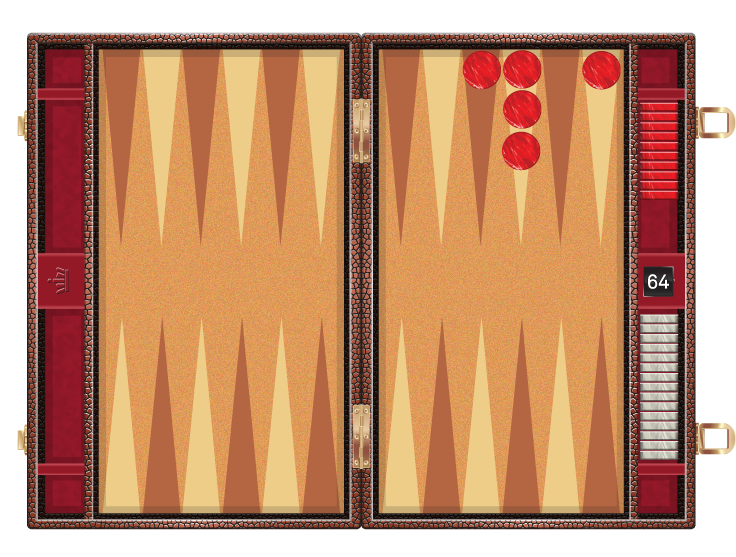
Gammon: 2 points (or 2× the cube value)
You bear off all your checkers before your opponent bears off any checkers.
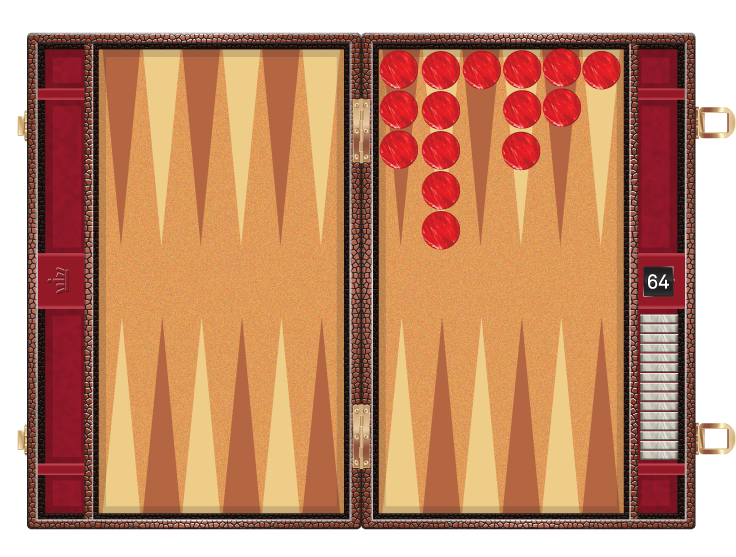
Backgammon: 3 points (or 3× the cube value)
This is the most decisive win in backgammon and scores triple the cube value. You bear off all your checkers while your opponent still has one or more checkers: on the bar, and/or inside your home board.
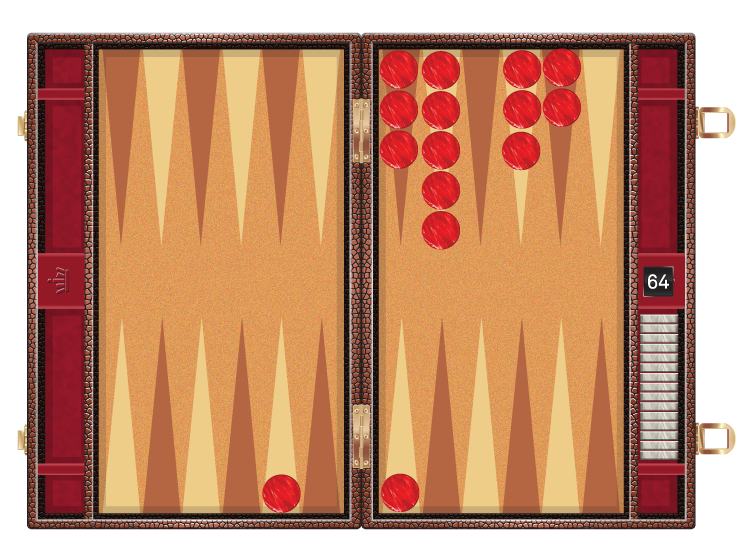
How To Use The Doubling Cube
The doubling cube, often called the cube, is a special die used to raise the stakes during a game of backgammon. It has six sides, marked with the numbers 2, 4, 8, 16, 32, and 64.
Starting Position
- At the beginning of each game, the cube is placed in the center of the board with 64 facing upward. This indicates that the cube is not yet in play.
- At this stage, the game can only be won as a single game (1 point), a gammon (2 points), or a backgammon (3 points), or their equivalent multiples if playing for money.
Offering a Double
- At the start of their own turn (before rolling the dice), either player may offer a double if they believe they have the advantage.
- To do this, the player announces “double,” turns the cube to show 2, and places it in front of their opponent.
Accepting or Refusing
- The opponent must now decide: Refuse (Drop): The game ends immediately, and the opponent who declined loses 1 point (the current stake). Accept (Take): The opponent takes the cube and keeps it on their side with the 2 facing up. The stakes are now doubled: A single game = 2 points A gammon = 4 points A backgammon = 6 points
Ownership of the Cube
- By accepting the double, the opponent becomes the owner of the cube. Only the cube’s owner may offer the next redouble.
- To redouble, the owner turns the cube to 4 and places it in front of their opponent.
- The opponent must again choose to accept or refuse: If refused, they lose the current cube value (in this case, 2 points). If accepted, the cube shows 4, and all possible outcomes are multiplied by 4: A single game = 4 points A gammon = 8 points A backgammon = 12 points
This process can continue with further redoubles, up to the maximum value shown on the cube (64).
Match vs. Single Game
Backgammon is played in two main formats: match play and single (cash) games.
- Match Play: Players compete to reach a predetermined point total. The first player to reach the target wins the match. Match play follows specific rules for scoring, the doubling cube, and optional variations such as the Crawford Rule.
- Single (Cash) Games: Each game is scored individually, with wins and losses settled immediately or tracked cumulatively over a session. The doubling cube is always in use, and gammons and backgammons count only if the cube has been turned (Jacoby Rule).
Each format has its own strategy and pace. Beginners often start with single games to learn the basics before moving on to match play.
For a deeper explanation, see our dedicated guides on How to Play Backgammon Matches and How to Play Backgammon Cash Games.
Backgammon Etiquette Rules
To ensure fairness and maintain good sportsmanship, players are expected to follow certain etiquette rules during play. Below are the most widely accepted practices.
Dice Rolling
- Each player must roll the dice only in their own right-hand half of the board.
- Dice cups are mandatory and should be shaken thoroughly before each roll.
- A valid roll requires the dice to bounce and tumble freely across the playing surface.
- Both dice must land flat on the board for the roll to count.
- A die that lands flat on top of a checker is generally considered invalid (though some modern discussions have suggested allowing it).
- A player may roll only after the opponent has picked up their dice at the end of their turn, or after the opponent has hit the game clock (in timed matches). Rolling early allows the opponent to declare the roll invalid.
Checker Play
- Players may only touch the checkers when it is their turn.
- Touching checkers, whether your own or your opponent’s, while it is not your turn is not permitted.
External Resources
For more detailed information about how to play backgammon or the official rules of modern backgammon as specified by the official federations.
- Backgammon Basics by US Backgammon Federation – Click here
- PFD File by the UK Backgammon Federation, Introduction to Backgammon by Chris Bray – Click here
Frequently Asked Questions
How many dice in backgammon?
Backgammon is played with two pairs of backgammon precision dice, one pair for each player. Besides the 2 pairs of dice, there is also a Doubling Cube in play.
How many pieces are in a backgammon set?
A standard backgammon set includes 15 checkers for each player, totaling 30 checkers, along with two dice and one doubling cube.
How to set up backgammon?
To set up backgammon, each player places their checkers on their respective starting points: two on the 24-point, five on the 13-point, three on the 8-point, and five on the 6-point. The board is then positioned so that each player’s home board is on their right-hand side.
How to play backgammon?
To play backgammon, each player rolls two dice and moves their checkers around the board according to the numbers rolled. The objective is to bear off all your checkers before your opponent.
How to play backgammon for beginners?
Beginners can learn to play backgammon by understanding the basic rules, such as moving checkers around the board and bearing them off. It’s also helpful to practice and gradually learn strategies for better gameplay.
How old is Backgammon?
Backgammon is believed to be one of the oldest board games in existence, with origins dating back over 5,000 years.
Who invented backgammon?
The precise origins of backgammon are unclear, as it evolved over centuries across various cultures. It likely originated in the Middle East or ancient Mesopotamia.
What happens when you roll doubles in backgammon?
When you roll doubles in backgammon, you get to move four times instead of just twice. For example, if you roll double 3s, you can move four checkers three spaces each, or one checker 12 spaces.
How to get off the bar in Backgammon?
To get off the bar in Backgammon, you must roll a number that corresponds to an open point in your opponent’s home board. You then enter the checker onto that point and continue playing as usual.