Backgammon Glossary
A
- Accept A Double – Refer to Take.
- Ace Point – The 1-point on a player’s side.
- Ace Point Game – A scenario where a player remains on the opponent’s 1-point, hoping to hit a blot during the opponent’s bear-off phase.
- Action Play – A move intended to cause a series of hits, usually after the opponent’s runners have escaped.
- Active Builder – A checker free to create another point.
- Advanced Anchor – An anchor on the opponent’s 4 or 5 point, or within their outer board.
- Airball – A bad roll that fails to make a point or hit an opponent’s blot.
- Anchor – A point secured by two or more of a player’s checkers on the opponent’s side.
- Attacking Game – See Blitz.
- Automatic Doubles – A rule where matching first roll numbers double the stakes.
- Awkward Number – A dice roll that leads to a less favorable position.
B
- Backdoor – A strategy involving hitting an opponent’s blot unexpectedly.
- Back Game – A strategy where the player holds multiple points in the opponent’s home board, aiming to hit blots as they bear off checkers.
- Backgammon – A game where the loser hasn’t borne off any checkers and has one or more checkers in the winner’s home board, tripling the cube’s value. See Gammon and Single Game.
- Bar – The dividing ridge on the board where hit blots are placed until re-entry.
- Bar Point – The 7-point for a player.
- Bear In – Moving a checker into the home board in preparation for bearing off.
- Bear Off – Removing a checker from the board by rolling a number matching its point, with the player who bears off all checkers first winning.
- Beaver – A situation where a player, believing they are favored after accepting a double, immediately doubles again to 4 without losing the option to double later.
- Black – A player using darker-colored checkers, or the checkers themselves.
- Blitz – An aggressive attack on blots in the opponent’s home board to close them out, also known as an Attacking Game.
- Block – A point occupied by two or more checkers on a player’s side of the board.
- Blockade – Several blocks set up to prevent the opponent’s runners from escaping.
- Blot – A single checker on a point, vulnerable to being hit and sent to the bar.
- Blot-Hitting Contest – An exchange where both players aim to hit blots and gain control of key points.
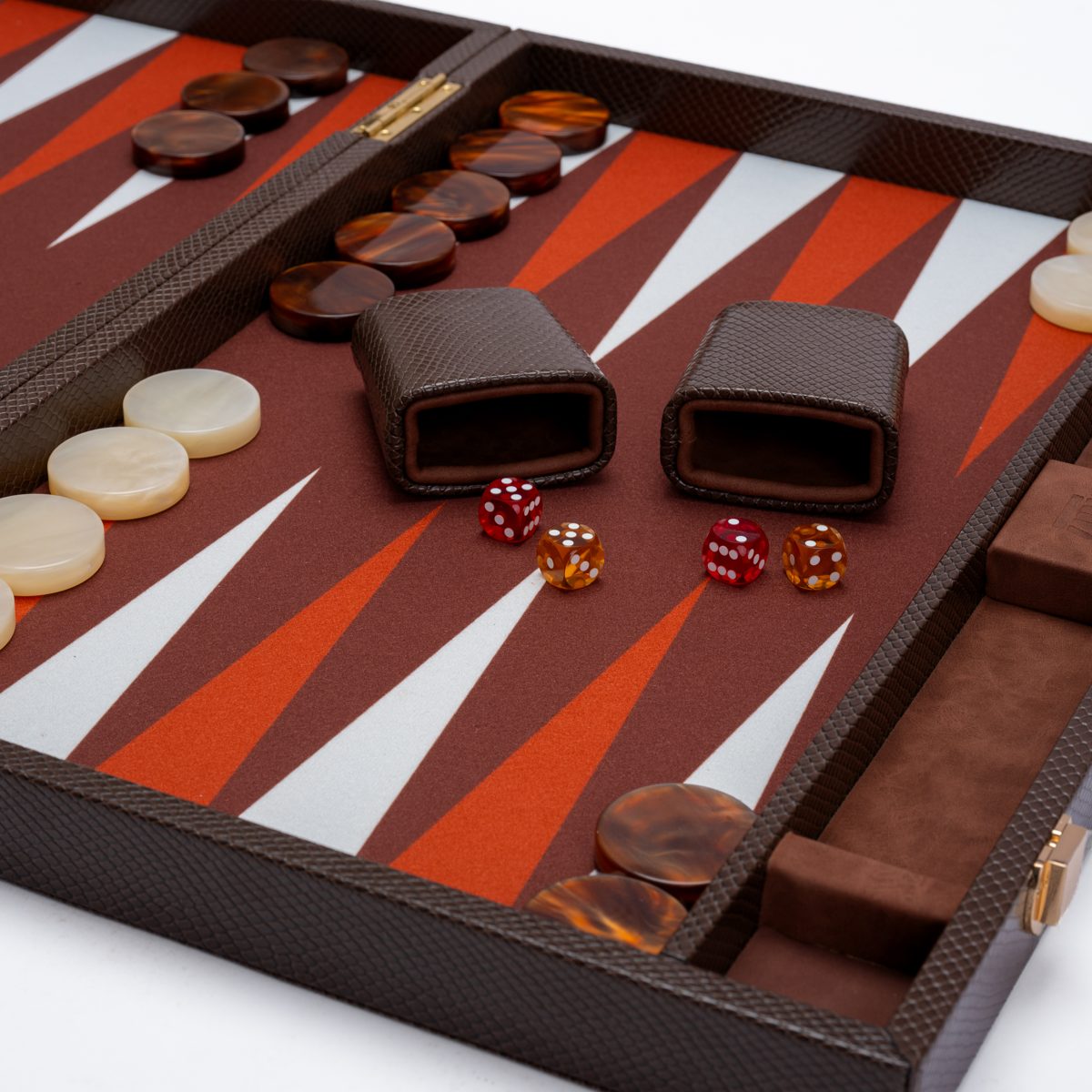
- Board – The backgammon board features 24 triangles called points, grouped into four quadrants and separated by a bar.
- Box – In a chouette, the player with the highest initial roll who plays against all other participants.
- Boxes or Boxcars – A roll of double sixes.
- Break Contact – Moving the last checkers past the opponent’s, starting the non-contact phase of the game.
- Break A Point – To move one checker from a point with only two checkers, leaving it open.
- Broken Prime – An incomplete prime with non-consecutive points. See Prime.
- Builder – A checker is positioned to make a new point.
- Bump – A term that is sometimes used to hit an opponent’s blot, sending it to the bar.
C
- Candlesticks – A formation where checkers are stacked high on a few points.
- Captain – In a chouette, the second-highest roller who makes decisions for the team.
- Cash – Offering a double expected to be declined, converting the player’s advantage into points.
- Centered Cube – The state of the doubling cube before any doubles have been offered.
- Checkers – The fifteen pieces each player moves around the board, also called men, pieces, or stones.
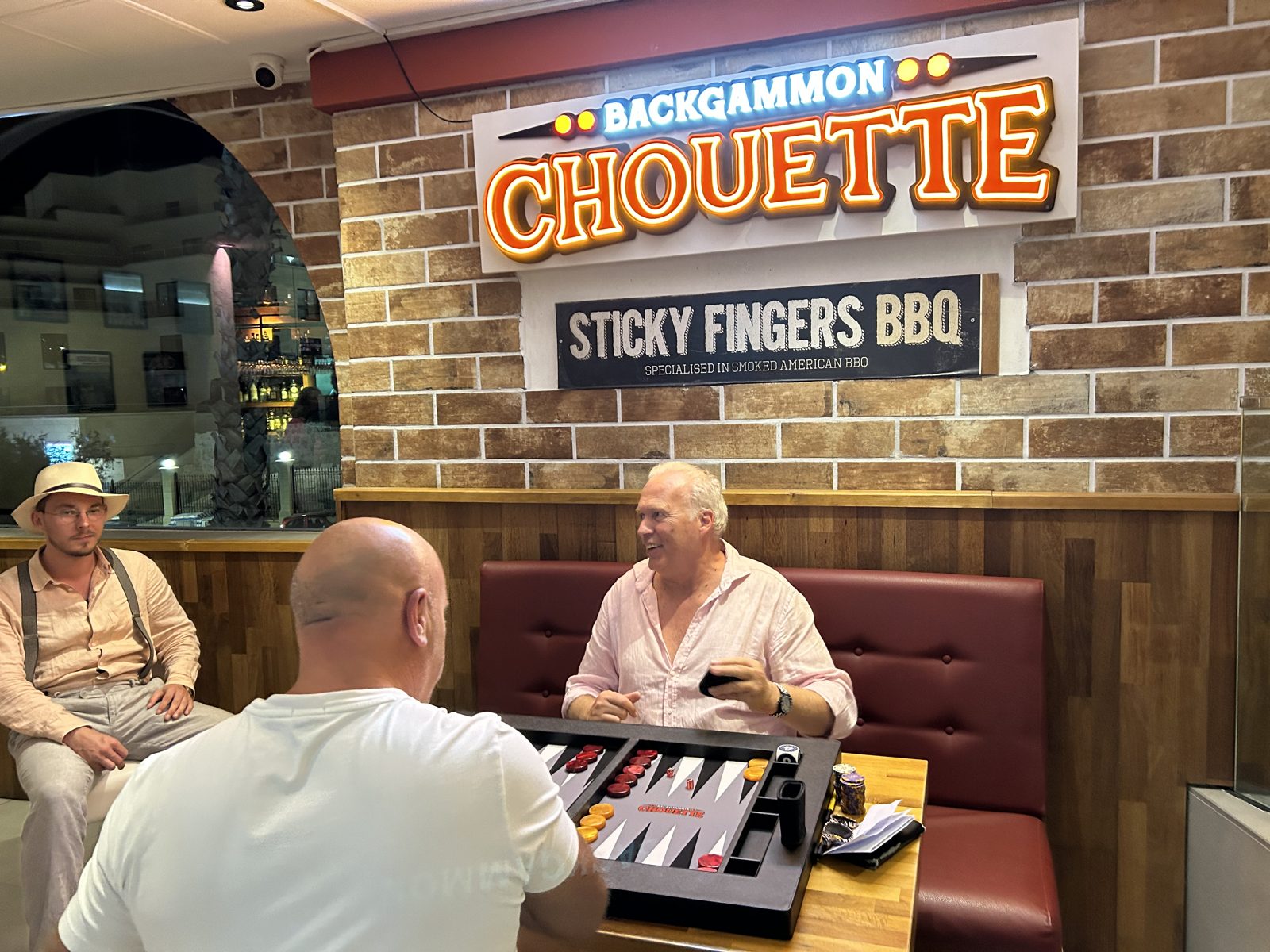
- Chouette – A variation of backgammon for more than two players often played in clubs.
- Clear – To move all checkers off a specific point, usually in preparation for bearing off.
- Close Out – Occupying all six points in your home board while the opponent has checkers on the bar.
- Closed Board – A home board where all six points are occupied.
- Closed Point – A point with two or more opposing checkers.
- Cocked Dice – Dice that land improperly, requiring a re-roll.
- Combination – The two numbers shown on a roll of the dice.
- Comeback Shot – A roll that results in a checker on the bar to hit an opposing blot.
- Communicate – Keeping checkers within six points of each other for mutual support.
- Contact – A game phase where hitting or blocking is still possible.
- Count – The total number of pips needed to bear off all checkers, usually referring to the difference between players’ counts.
- Coup Classique – A strategic play where a player sacrifices one checker to achieve a strategic advantage to turn around a hopeless game into a favorable position
- Cover a Blot – Adding a second checker to a blot to secure the point.
- Cow – Slang for a doubling cube.
- Crawford Rule – In a match, if one player is one point away from winning, doubling is not allowed in the next game.
- Crossover – Moving a checker from one quadrant to another.
- Crunch – Forced moves that break up a desirable position due to a lack of alternatives.
- Cube – The doubling cube is used to raise the stakes of the game.
- Cube Decision – The choice to offer, accept, or decline a double.
- Cube Ownership – Indicates which player can next offer a double.
D
- Dance – Rolling a combination that cannot be played, like rolling double sixes when the 6-point is blocked.
- Dead Checker – An extra checker deep in the home board that cannot be used effectively.
- Dead Cube – A doubling cube that has no strategic value in match play.
- Dead Number – A roll that cannot be played in the current position.
- Decline A Double – See Drop.
- Deep – The lower points in a player’s home board, typically the 1 and 2 points.
- Dice Cup – A cup used to shake and roll dice, usually one per player.
- Dice – Six-sided cubes numbered from 1 to 6, typically two pairs per game.
- Dilly Builder – A spare checker only useful for making points deep in the home board.
- Direct Hit – A shot within six points that can hit an opponent’s blot.
- Direct Shot – A shot within six points.
- Disengage – See Break Contact.
- Diversify – Positioning checkers to maximize good future rolls, even if it increases risk.
- DMP – 1 point match (Double Match Point)
- Double – An offer to increase the game’s stakes. The opponent can accept or drop, ending the game with the current stake.
- Double Elimination – Tournament format whereby you have 2 lives before elimination.
- Double Game – See Gammon.
- Double Hit – Hitting two of the opponent’s blots in one turn.
- Double Match Point or DMP – A match where both players need one point to win, or the doubling cube is at a level where the winner takes the match.
- Doubles – Rolling the same number on both dice.
- Doubles Consultation – Tournament format 2 vs 2 players who can consult during their turn.
- Doubling Cube – A six-faced die with numbers 2, 4, 8, 16, 32, and 64, indicating the game’s stakes.
- Doubling Window – The range of conditions under which a double should be offered or accepted.
- Drop – Refusing a double and conceding the game at the current stake.
- Drop Point – The maximum equity point where dropping a double is correct.
- Duplication – Positioning checkers so multiple good moves require the same roll.
E
- Early Game – The initial phase of the game where the primary focus is on establishing a strong position.
- Edge Of A Prime – The point directly in front of a prime.
- Efficient Double – A double made at the most effective point, making the opponent’s decision difficult.
- Empty Point – A point on the board with no checkers on it.
- End Game – The phase when bearing off begins or no more hitting/blocking is possible.
- Enter – Moving a checker from the bar to a point in the opponent’s home board.
- Equity – The expected value of a position, considering all possible outcomes and their probabilities.
- Escape – Successfully moving a checker out from a blocked position.
- Exposed Checker – A blot within range of a direct shot.
- Extra Blot – An additional blot that results from a play, increasing vulnerability.
F
- Fan – See Dance.
- Forced Move – A situation where there is only one legal move available.
- Forced Play – A roll that leaves only one legal move.
- Fly Shot – An indirect shot with few hitting combinations.
- Forward Game – See Running Game.
- Free Drop – After the Crawford game, the leader can drop a double without reducing the games needed to win.
- Free Drop Vigorish – The slight advantage for the leader to drop a double without affecting the match outcome.
- Freeze A Builder – Positioning a checker to restrict the opponent’s active builders.
- Full Prime – A prime of six consecutive points, completely blocking the opponent.
G
- Gammon – A game where the loser hasn’t borne off any checkers, doubling the stakes.
- Gammon Price – The value of winning a gammon compared to a single game.
- Gammon Rate – The percentage of games ending in gammons or backgammons.
- Gammon Vigorish – Extra equity due to the chance of winning a gammon.
- Gap – The space between established points.
- Go Out – Winning enough points to win the match.
- Golden Point – A player’s 20-point, the opponent’s 5-point.
- Game Winning Chances, or GWC – The probability of winning the current game.
H
- Half Roll – One number on a pair of dice.
- Heavy Point – A point with more than three checkers.
- Hit – Landing on a point occupied by a single opposing checker, sending it to the bar.
- Hit And Cover – Hitting an opponent’s blot and then securing the point.
- Hit Loose – Hitting a blot and leaving your own blot exposed.
- Holding Game – Securing points on the opponent’s side to hinder their checkers.
- Holland Rule – An optional rule in post-Crawford games, allowing doubles after both players have rolled twice.
- Home Board – The quadrant where players bear off checkers points 1 through 6.
I
- Inactive Builder – A checker that could make a point in the future but is currently occupied.
- Indirect Shot – A shot more than six points away.
- Inner Board – See Home Board.
J
- Jacoby Rule – Gammons and backgammons count as single games if no doubles are offered, speeding up play.
- Jeopardy – The potential for difficult rolls in future turns.
- Joker – An exceptionally lucky roll that changes the game’s outcome.
- Jump – Moving a checker past a series of blocked points.
K
- Kauder Paradox – In money play with the Jacoby Rule, a position can be both a proper double and a proper beaver.
- Kibitzer – A spectator who gives unsolicited advice.
- Kill A Checker – Moving a checker deep into the home board where it is less effective.
- Kill A Number – Creating a position where a specific roll cannot be played.
L
- Late Game – The phase where bearing off becomes the primary focus.
- Live Cube – A doubling cube that is still in play and can be used for further doubling.
- Lock Up – Securing a strong position that is difficult for the opponent to break.
- Long Prime – A series of four or more consecutive occupied points.
- Lover’s Leap – Moving 24/13 with an opening 65 roll.
M
- Make A Point – Securing a point by placing two checkers on it.
- Mandatory Double – In match play, a double based solely on match score.
- Market Gainer – A sequence of rolls leading to a position where the opponent would take a double.
- Market Loser – A sequence of rolls leading to a position where the opponent would drop a double.
- Match – A series of games ending when one player wins the required points.
- Match Equity – The value of a position considering the match score.
- Match Equity Table – A table showing the probability of winning a match from various scores.
- Match Play – Tournament play where participants compete in matches, progressing through rounds.
- Midgame – The middle phase of the game where strategies and tactics become more complex.
- Match Point – The score where the leading player needs one more point to win.
- Midpoint – A player’s 13-point.
- Mochy Millions – Tournament format based on single cash games with increasing stakes.
- Money Play – Playing independent games with stakes, doubling the value for gammons and backgammons.
- Move – Advancing a checker based on dice rolls, including entering, advancing, or bearing off.
- Mutual Holding Game – A game where both players maintain holding positions.
- Match Winning Chances, or MWC – The probability of winning the match based on the current score and game position.
N
- Neil’s Numbers – A formula by Neil Kazaross to estimate match equity based on the match score.
- Non-Contact Position – A board state where the checkers of the two players no longer threaten each other.
- Normalized Match Score – The match score expressed as points needed by both players, e.g., 5-1 in a 7-point match is -2, -6.
O
- On Roll – The player on-turn to double or roll the dice for their turn.
- Opening Roll – The first roll of a game, with each player rolling one die.
- Open Point – A point not occupied by two or more opposing checkers.
- Otter – An immediate redouble after accepting a raccoon, retaining the cube.
- Outer Board – The quadrant away from the home board, points 7 through 12.
- Outfield – See Outer Board.
- Outside Prime – A prime that is located in the outer board.
- Own The Cube – The most recent player to accept a double, who can offer the next double.
P
- Partner For The Box – In large chouettes, the box may take a partner from the team, chosen by rotation or lot.
- Pass – See Drop.
- Pay Off – Leaving a blot exposed to the opponent’s potential direct shot.
- Pick And Pass – Hitting an opponent’s blot and covering one’s own blot, making the point.
- Pick Up – Ending the turn by picking up the dice.
- Pip – A dot on the dice indicating its value, or a unit of distance on the board.
- Pip Count – The total number of points needed to bear off all checkers from the current position.
- Play – The moves made to fulfill a dice roll.
- Play On – Choosing not to double because the player believes they have a strong enough advantage to win more points.
- Point – One of the 24 triangles on the board, or a unit of score in match play.
- Point On A Blot – Hitting an opponent’s checker with two of your own, making the point.
- Pressure – Moving a runner to force the opponent to cover or move a blot.
- Prime – Several consecutive points held by a player, blocking the opponent’s checkers.
- Priming Battle – A strategic contest where both players try to build and maintain primes.
- Precision Dice – Highly precise manufactured dice to casino standards.
- Proposition, or Prop – An arranged position played multiple times to resolve a dispute over the best play.
- Pure Play – Checker placement aimed at creating a prime, involving some risk.
- Pure Race – See Race.
Q
- Quadrant – One quarter of the board, each with six points.
R
- Raccoon – An immediate redouble after accepting a beaver.
- Race – A game phase with no contact, focusing on bearing off checkers first.
- Recirculate – Allowing a blot to be hit to gain time or attempt hitting the opponent’s checkers.
- Recube – See Redouble.
- Recube Vigorish – Extra equity due to the potential for redoubling.
- Redouble – Any double after the first, only by the cube owner.
- Reenter – See Enter.
- Reference Position – A known position used to assess similar positions.
- Refuse A Double – See Drop.
- Roll A Prime Forward – Creating a new point at the prime’s edge using checkers from the rear.
- Roll Out – Analyzing a position by playing it out multiple times with different dice rolls.
- Rollout – The equity estimate from rolling out a position.
- Round Robin – Tournament format like a league whereby each opponent plays each other.
- Run – Moving a checker, especially from the opponent’s home board.
- Runner – A checker on the bar or in the opponent’s home board.
- Runners – The two checkers on the opponent’s 1-point at the start of the game, needing to travel the board.
- Running Game – A strategy where a player ahead in the race focuses on bearing off checkers quickly with minimal interaction.
S
- Safe Play – A move that minimizes the risk of leaving blots.
- Save Gammon – Avoiding a Gammon loss by bearing off at least one checker.
- Settlement – A points payment based on the fair value of a position.
- Shift Points – Giving up one point to make a lower point.
- Shot – An opportunity to hit a blot, either direct or indirect.
- Shut Out – See Close Out.
- Single Elimination – Tournament Knock Out Format whereby you will be eliminated as soon you lose.
- Single Game – A won game that is neither a gammon nor a backgammon.
- Slot – Leaving a single checker on a point with the intention of making it on the next turn.
- Slotting – Placing a single checker on a point with the intention of covering it later.
- Speedgammon – Tournament format with limited time on the clock.
- Spare Checker – An extra checker used for hitting or making a point without leaving a blot.
- Split – Separating two checkers, usually on the 24-point, and leaving them as blots.
- Squeeze – Taking advantage of the opponent’s need to make a legal play.
- Stacked – Having multiple checkers on a single point, potentially reducing flexibility.
- Stake – The wager amount in a game, multiplied by the doubling cube’s value.
- Stakes Play – See Money Play.
- Steam – Losing composure and making poor plays due to frustration or unlucky rolls.
- Strip A Point – Removing all but two checkers from a point.
- Stripped – A position with no spare checkers, prone to awkward rolls.
- Super Jackpot – Standard side event (tournament format) often with higher buy-ins than the main event.
- Swing – Tournament format invented by Play65, similar to Mochy Millions
- Swiss System – Tournament format whereby players play random players in an adjusted league format
- Switch Points – Moving checkers to change which points are occupied, often for strategic reasons.
T
- Take – Accepting a double to continue playing at twice the stakes.
- Take/Drop Decision – Choosing whether to accept or decline a double.
- Tempo – A unit of time in positional development is equal to half a roll.
- Tempo Move – A hit designed to reduce the opponent’s ability to hit a blot or make an important point.
- Thorp Count – A formula by Edward O. Thorp for doubling decisions in the end game, considering pip count, checkers in play, and home points covered.
- Timing – The relative rate of checker advancement, with the player behind in the race having more time.
- Too Good – A position where a player should not double despite a clear drop, as playing on offers higher equity.
- Trap Play – Attempting to squeeze the opponent off their anchor to close out blots and win a gammon.
- Triple Elimination – KO Tournament Format whereby you have 3 lives before elimination
- Triple Game – See Backgammon win.
- Turn The Cube – See Double.
- Turn the Corner – Moving a checker past the opponent’s prime and into the home board.
- Two-way Forward – A strategy where a player has two potential winning plans.
U
- Up in the Race – Being ahead in the pip count, with fewer pips to bear off than the opponent.
- Under The Gun – A blot in the opponent’s home board within direct range of multiple builders, at risk of being pointed on.
V
- Vigorish, or Vig – The small considerations affecting the total equity of a position, include free drop vigorish, gammon vigorish, and recube vigorish.
- Volatility – The potential for positional equity to change significantly after the next roll.
W
- Wastage – The expected loss in pips from dice rolls not fully used during bearoff.
- White – A player using lighter-colored checkers, or the checkers themselves.
X
- X-22 – Nickname for Paul Magriel.
Y
- Yvonne’s Law – A humorous term for rolling a combination that leaves all possible moves unfavorable.
Z
- Zeno’s Paradox – A term describing an endgame situation where a player is forced to waste rolls, making it seem like bearing off will never be completed.