

Backgammon Chouette
How to play
Gambling on backgammon is as old as the game itself. But the real boom in gambling backgammon began in the 1930s, when the doubling cube was introduced. This simple cube transformed backgammon into the perfect gambling game: a volatile contest where players could raise the stakes at any moment.
It didn’t take long before players pushed the idea even further. Out of the doubling cube was born a new multiplayer variant that maximized backgammon’s volatility and excitement: Backgammon Chouette. In Chouette, the stakes can skyrocket within a single game, creating dramatic swings of fortune. It is often described as the most intense gambling game in the world, fast, volatile, and thrilling.
While Chouette has long been a favorite among professionals and grandmasters, it is also surprisingly welcoming to beginners. Thanks to the consultation rule, where team members can advise the captain, even new players can join the action quickly and learn the game as they play.
Introduction to Backgammon Chouette
Backgammon Chouette is the ultimate gambling version of backgammon, played with 3 to 6 players. It follows the official backgammon cash game rules, including the use of the Doubling Cube.
One player competes against all the others (who form a team) in a single money game for an agreed stake per point.
- The player competing alone is called the Box.
- The team player who sits at the board and moves the checkers is called the Captain, and has final responsibility for all moves.
- The Captain may consult the team under certain conditions, but ultimately decides and is the only one allowed to move the checkers.
Each team member bets individually. This means the Box plays against the Captain and every other team member. For example, if the stake is €1 per point, every team member bets €1, while the Box bets €1 against each of them.
Each participant has their own cube. When the Box doubles, the stake doubles against the Captain and every team member separately. These players may redouble back independently.
Games can be won as a single game (1x stake), a gammon (2x stake), or a backgammon (3x stake). Settlements may be made after each game, or recorded on a score sheet and paid out at the end of the session.
When the Box wins, they collect winnings from each opponent individually. When they lose, they pay each opponent separately.
Positions rotate, so everyone takes turns being a Team Member, Captain, and Box. The Box position is the most crucial: you can win or lose the most in this role.
Required Equipment to Play Chouette
To play Backgammon Chouette, you need:
- 3–6 Players
- One Backgammon Board
- Two sets of 15 Checkers
- Two Pairs of Precision Dice
- Two Dice Cups
- One Doubling Cube per player
Discover our Backgammon Chouette Doubling Cube Set
The Objective of the Game
Chouette is played as a cash game, where the goal is to win as many points (stakes) as possible. There is no match score, after each game you win or lose points, then move on to the next. The more points you win, the more money you earn.
Understanding Roles
- Box: The Box is the central player, competing alone against the Captain and the rest of the Team. The Box wagers one stake against each opponent individually, with a separate doubling cube for every match-up. As a result, the outcome of a single game, especially a gammon or backgammon with cubes in play, can multiply across all opponents simultaneously, creating significant swings in points.
- Captain: Leads the Team, makes the final checker moves and is first in line to reveal his cube decision.
- Team Members: Advise the Captain, but do not make final decisions. They act independently regarding cube actions.
Determine the Stake
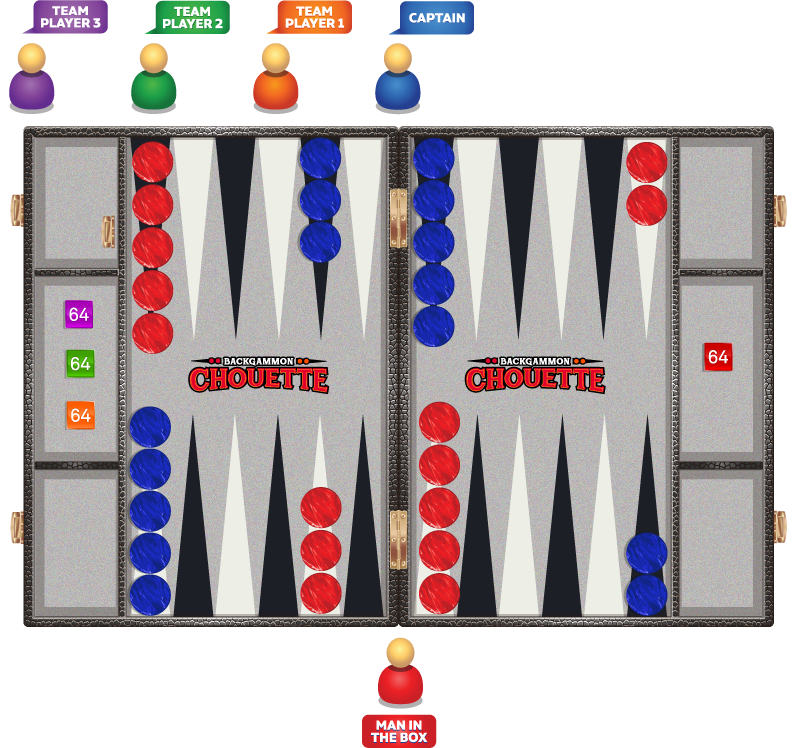
Before play begins, all participants agree on a stake per point. To keep calculations simple, the stake is usually set at an easily multiplied value such as 1, 2, 5, or 10. Over the course of a single game, the actual value at risk can increase dramatically through the use of the doubling cube, and may be multiplied further in the case of a gammon (x2) or backgammon (x3).
Example with Five Players (€1 per point):
In this setup, the Box plays against four opponents, one Captain and three Team Members. The Box wagers €4 in total (€1 against each opponent), while each Team Member risks €1.
- Without doubling: Single game win: Box gains €4 Gammon: Box gains €8 Backgammon: Box gains €12 If the Box loses, payouts are reversed: each Team Member receives €1 for a single game, €2 for a gammon, and €3 for a backgammon.
- With doubling:
Each turn of the doubling cube multiplies the stakes. For example, after one double (cube at 2), the Box would win or lose €8 for a single game, €16 for a gammon, and €24 for a backgammon.
Deciding Player Starting Positions
Only the Box and Captain roll dice and move checkers. Team members observe and may double independently.
To determine starting positions:
- All players roll one die.
- Highest roll = Box.
- Second highest = Captain.
- Others follow in descending order.
- Ties are re-rolled.
Order of Play and Player Rotation
After each game, positions rotate:
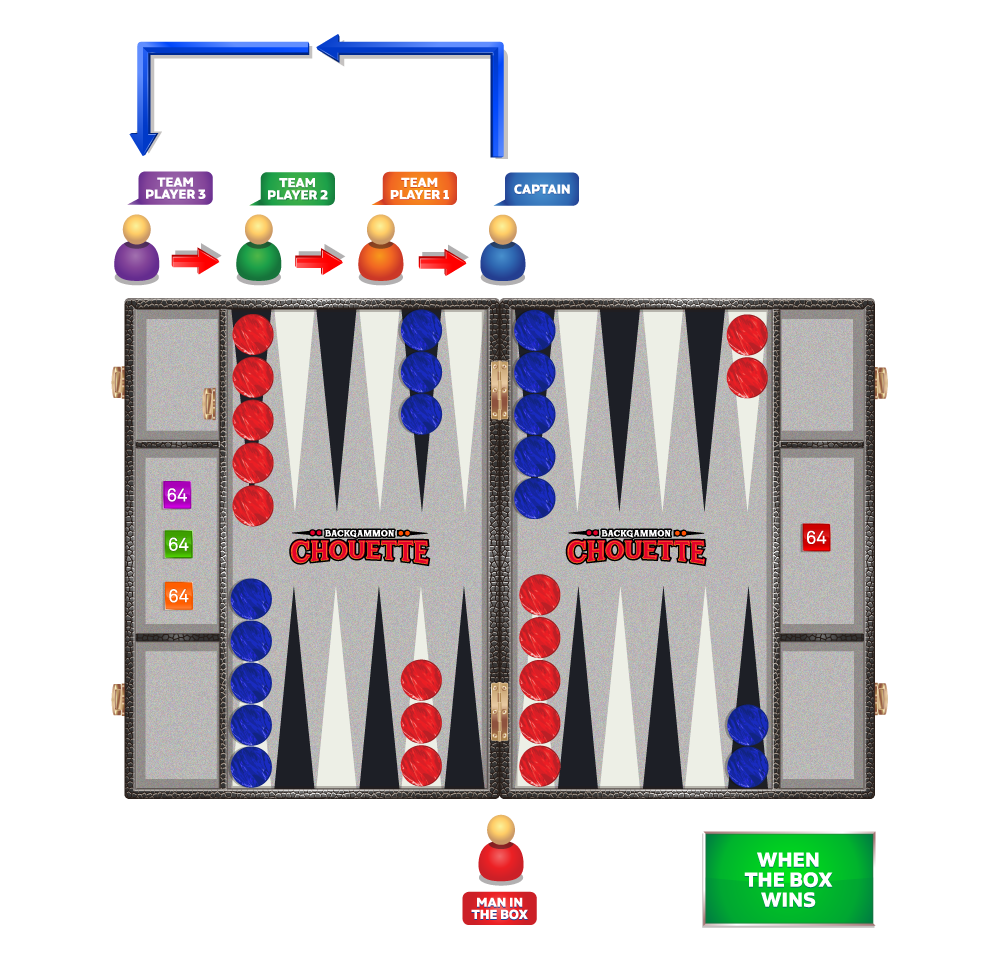
- If the Box wins: They remain Box. The Captain rotates out and is replaced by the next team member.
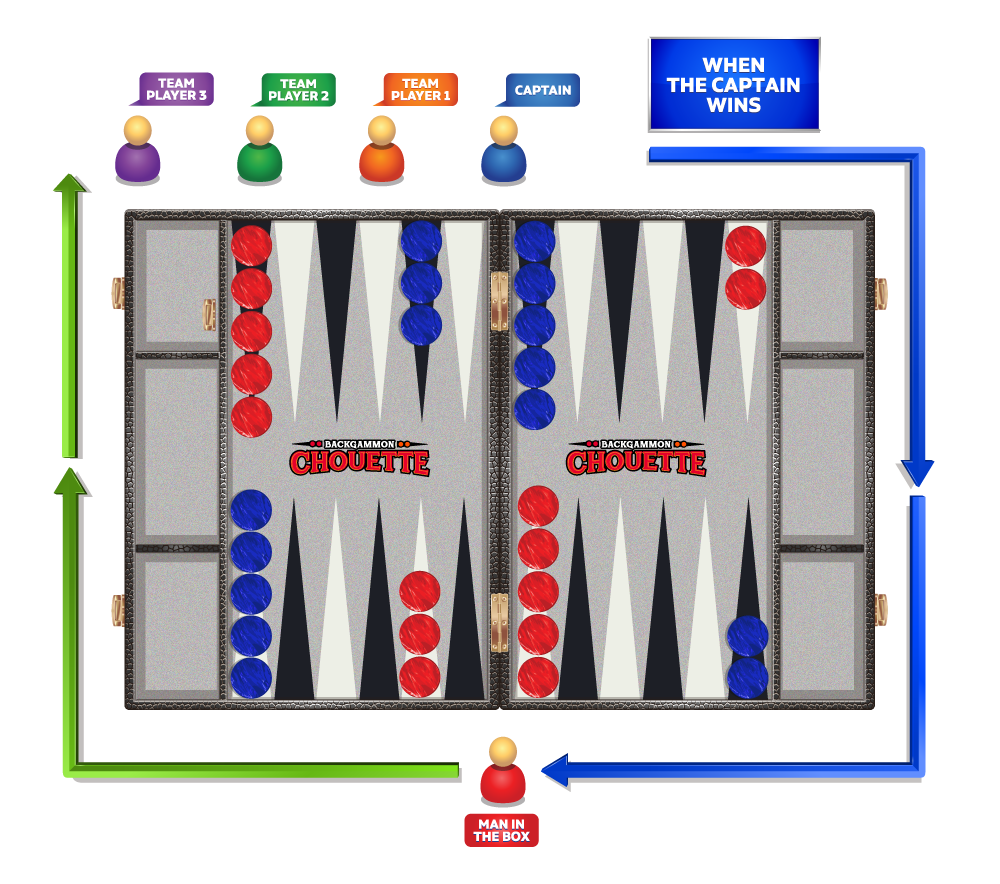
- If the Captain wins: The Captain becomes the new Box. The losing Box joins the back of the Team.
Important Rule: The Box remains Box as long as they defeat the Captain (even if they lose to other team members individually).
Rotation if the Box Wins
If the Box remains undefeated, they continue in the Box position for the next game. The losing Captain steps down and moves to the back of the rotation order, while the next Team Member takes over as Captain. In our example, if Team Member 2 (Orange) becomes Captain, the following player in line (Green) advances to first position in the queue to be Captain in the next round.
Rotation if the Captain Wins
If the Captain wins, they advance to become the Box in the next game. The player who lost as the Box gives up their position and moves to the back of the Team rotation. In our example, Orange becomes the new Captain and takes over, moving the checkers.
The Box is the most important and financially significant position in Chouette. Playing alone against all opponents, the Box has the potential to win or lose the most in a single game. A successful gammon or backgammon with the cube in play can lead to substantial gains, but losses in this role can be equally severe.
Backgammon Chouette Rotation Rules
With multiple players and separate doubling cubes in play, the Box may sometimes win against certain Team Members while losing against others. To determine whether the Box keeps its position, the following principle applies:
The Box remains in the Box as long as they defeat the Captain.
- Team Member drops: A Team Member may independently decline a double from the Box. In that case, they lose their stake and are out of the current game, but their rotation order within the Team remains unchanged.
- Captain drops: If the Captain declines a double from the Box, they immediately lose their stake and their position. The Captain moves to the back of the Team rotation for the next game.
- Replacement Captain: When the Captain declines, but other Team Members accept, the highest-ranking Team Member who accepted becomes the acting Captain for the remainder of that game.
- Impact on rotation: Accepting or refusing a double does not affect a Team Member’s rank, except when the Captain refuses. The Captain always loses their position if they drop, even if other Team Members later win the game.
Example: The Box doubles. The Captain declines, the first Team Member in line also declines, but the second Team Member accepts. That player becomes acting Captain for the rest of the game. If they win, they do not become the next Box but only advance within the rotation order. The next player in line after the Captain becomes the new Box, even though they technically lost the previous game.
Entering or Exiting a running game: Any player may choose to stop playing, but only at the end of a game, regardless of whether they are winning or losing. If seats are available, a new player may join before the start of a game, always entering at the back of the Team queue.
Skipping the Box: It is not permitted for a player to leave the game just before becoming the Box and then re-enter as the lowest-ranked Team Member. Skipping the Box position would provide an unfair advantage and is therefore strictly forbidden.
When the Captain doubles: If the Captain doubles but no other Team Members do, and the Box declines, the Captain wins immediately and becomes the next Box. The next player in line becomes acting Captain for that round to finish the game.
With multiple players and double dice in play, the man in the BOX may win against some team members but lose against others. To determine whether the BOX maintains its position, the following important rule applies:
Automatic Doubles
If both players roll the same number on the opening roll, the cube is automatically doubled to 2. Then a new opening roll is made.
Variants include:
- Unlimited Automatic Doubles: Every tie doubles the cube again.
- Limited Automatic Doubles: Allowed only once or twice.
- Forward doubles: Automatic doubles carry into the next round.
- Box decides: Box chooses whether Automatic Doubles apply.
- None: Automatic doubles are not used.
If no prior agreement exists, Unlimited Automatic Doubles apply by default.
Rules Regarding the Use of the Doubling Cube
In Backgammon Chouette, the Box, the Captain, and each Team Member have their own cube, which governs the stakes between the Box and that specific opponent.
- Cube in Play: The doubling cube only influences the game once it has been turned and accepted, or when the Automatic Doubles rule applies.
- Jacoby Rule: Gammons and backgammons count only if the cube is in play. If no doubling has occurred, they are scored as a single game.
- Beavers Allowed: A player who is doubled may immediately redouble while retaining the cube. The original doubler must accept or drop.
- Raccoons Not Allowed: A player who has been beavered may not redouble again in the same sequence.
Team and Cube Actions
- Team Members must follow the rotation order when making decisions to double, take, or pass.
- On the Captain’s turn, any Team Member may propose a double to the Box. In such cases, they must notify the Captain first by saying “hold your roll” (or similar).
Initial Doubles
- If the Box offers the first double of the game, it must be offered to the entire Team.
- If two or more Team Members simultaneously offer their initial double, the Box must either accept all of them or drop all.
- The Box may, however, make different decisions on initial doubles offered at different points in the game.
Subsequent Doubles
- For non-initial doubles, simultaneous cube actions must be treated as a group: the Box must take or drop all such offers together.
- Example: If two Team Members redouble at the same moment, the Box cannot accept one and decline the other; the decision applies to both.
Absent Team Members
- If a Team Member is not present at the table, their cube is automatically played in line with the Captain’s decision.
Consultation
Consultation refers to the discussions between Team Members and the Captain regarding checker moves or cube decisions.
The following rules always apply:
- Final Authority: The Captain has the final say on all checker plays. Only the Captain may physically move the checkers, while Team Members handle only their own cubes.
- Cube Action Order: Team Members must act on cube decisions (double, take, or pass) according to the established rotation order.
- No Outside Input: Players who are not currently part of the game may not participate in any consultation or discussion.
- Open Information: Pip counts are considered open information and may be shared freely at any time.
Consultation Variants in Backgammon Chouette
In Backgammon Chouette, different approaches may be agreed upon regarding consultation between the Captain and Team Members. The main variants are:
- Full from Start
Consultation is allowed from the beginning of the game. Both checker play and cube decisions may be discussed. - Checker Play Only from Start
Consultation is allowed from the beginning, but limited to checker play. Cube decisions are made individually by each Team Member. - Full after the First Double
Consultation becomes allowed once a Team Member has a cube in play. At that point, both checker play and cube decisions may be discussed with the Captain and other Team Members. - Checker Play Only after the First Double
Consultation becomes allowed once a Team Member has a cube in play, but is limited to checker play only. Cube decisions remain individual. - No Consultation
The Captain plays independently against the Box. Team Members may not advise on checker play and are only responsible for their own cube actions. When this variant is used, the Jacoby Rule applies: gammons and backgammons count only if the cube is in play, and only for players who doubled or accepted a double.
The choice of consultation style can significantly affect gameplay. Limited or no consultation places greater responsibility on the Captain, requiring Team Members to adapt to the Captain’s decisions.
Scoring and Payout
The payout in Backgammon Chouette is as follows:
- Single Win – 1 x the original stake
- Gammon Win – 2 x the original stake
- Backgammon Win – 3 x the original stake
The outcome of the game (single, gammon, or backgammon) is then multiplied by the current value of the doubling cube.
The Backgammon Chouette Score Sheet
Instead of settling after each game, scores are recorded on a score sheet and updated round by round. The sheet tracks each player’s points throughout the session, with payment settled at the end. This is the most common method used in clubs, as it provides a clear record of both results and player rotation. The scoresheet is often maintained by the most experienced player, who records both the scores and the order of play.
While experienced players can manage with a simple handwritten table, newcomers often find it more challenging to keep track of everything. To make the process easier, we have designed a dedicated Chouette scoresheet that helps run the game smoothly.
The scoresheet below is free to download and comes with clear instructions on how to use it effectively.
Download Backgammon Score Sheet Front
Download Backgammon Score Sheet Back
Note: This scoresheet is designed to be printed double-sided and is suitable for up to 6 players. If you want to play with more than 6 players, you can use an additional scoresheet and attach it to the right side of the original scoresheet.
How to use the Chouette Score Sheet?
To understand how to use and fill in the scoring sheet, read the following instructions carefully.
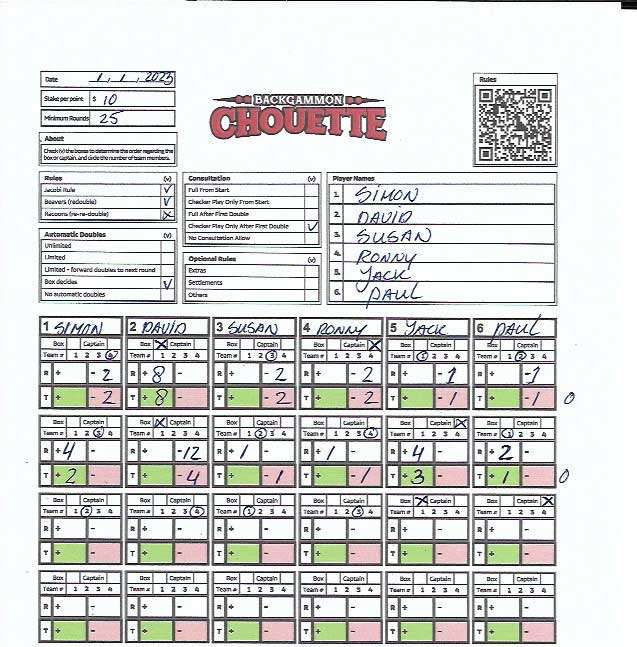
Player Names and Session Settings
- Write down the names of all players.
- Note the agreed rules at the top of the sheet: stake per point, minimum number of rounds, consultation rules, automatic doubles, beavers and raccoons, and any optional rules (e.g., settlements).
- For clarity, also write each player’s name above their column.
Track Player Roles
- At the start of each round, mark which player is the Box.
- Circle the player acting as Captain.
- Indicate the Team Member who is first in line to become Captain in the next rotation.
Record Round Results
- Each block on the sheet represents one game (round).
- Use the row marked R (+/–) to record the outcome: “+” for points won “–” for points lost
- Each result should reflect the multiplier from the doubling cube and whether the game ended as a single, gammon, or backgammon.
Update Totals
- After each round, update the T row (Total) for every player.
- Add points to the previous total when a player wins, or subtract them when they lose.
- This creates a cumulative record of each player’s standing throughout the session.
Verify Accuracy
- At the end of each round, check that the total of all scores equals 0.
- This confirms that a corresponding loss has balanced every win.
Definition of Terms
- Box: The player who plays alone against the Captain and his team.
- Captain: The Captain is the team’s player, the only team member allowed to touch the checkers, and has the final decision on moves.
- Beavers: Instant redouble when you receive a Double while holding the Cube.
- Raccoon: When you get “Beavered” you have the option to redouble again without getting possession of the Cube.
For more information about Backgammon terms and meanings, visit our Backgammon Glossary page
Optional Rules (Not Advised)
The following rules and options are sometimes used during Chouette sessions. While they can add variety, they generally complicate the game and slow down play. For this reason, I recommend avoiding them.
- Partner of the Box
Allowing the Box to take a partner makes the game unnecessarily complex, particularly when it comes to payouts. If the Chouette grows too large, the best solution is simply to split the table and start a second Chouette. - Settlements
Settlements are often used by players who have chosen stakes that are too high for their comfort level. In practice, they complicate scoring, delay the game, and reduce the excitement of playing out high-cube situations, the very essence of Chouette. If a player is uncomfortable with large swings, it is better to play at lower stakes. - Extras
Extras can be entertaining for experienced players but add extra layers of bookkeeping and slow down the flow of the game. For most groups, especially beginners, they are better left out.
Recommendation: Rules that slow down or complicate the game are not advised. Keep the format simple, fast, and exciting, the way Chouette is meant to be played.
Partner of the Box
In larger Chouettes with eight or more players, it is sometimes permitted for the Box to take a partner. The offer of partnership is made in rotation, beginning with the Captain and continuing down the line of Team Members. If no one volunteers, a partner may be selected by lot from among the Team Members, excluding the Captain.
Settlements
In Backgammon Chouette, settlements allow players to cut short a game and agree on a result, often when high cubes create large swings. Settlements save time, prevent lopsided outcomes, and give players more flexibility in handling risky situations.
General Principles
- Settlements can be offered at any point during a game, usually when cubes reach eight or higher.
- A player may propose receiving or paying a certain number of points to end their involvement in the game.
- The opponent may accept, decline, or counteroffer.
- Settlements can involve the Box and specific Team Members, or even be arranged between Team Members themselves.
Settlement Rules
- Jacoby Rule in Settlements: Unless cubes are in play, gammons and backgammons do not count.
- Whole Points Only: Scores are recorded to the nearest whole point. If a fractional point arises, it is “rolled off”, both players roll two dice, and the higher total (ignoring doubles as extra) wins the extra point. Players may alternatively agree on another fair method, but only whole points go on the scoresheet.
- Box Priority: The Box may preempt settlements between Team Members. For example, if one Team Member offers another a share in their cube, the Box may choose to buy them out instead.
- Selective Offers: The Box may make settlement offers to one or more opponents without being obligated to offer the same to all Team Members. “First come, first served” applies, late accepters miss out.
- Box Partnerships: If the Box has a partner (less common in simplified rules), settlements only affect points won or lost, not who rolls the dice or who stays Box. If a settlement removes all financial interest for a player, they lose any consultation rights for the remainder of that game.
Example of a Settlement
Suppose the stake is €1 per point. The Box is holding cubes at eight against three Team Members.
- If the Box loses a gammon, it risks paying 16 points to each Team Member (a giant swing).
- To reduce this risk, he offers each Team Member a settlement of 6 points, which ends the game immediately.
Possible outcomes:
- Team Member A accepts → the Box pays A 6 points, and A is out of the game.
- Team Member B declines → continues playing for the full cube stakes.
- Team Member C tries to accept, but after B hesitates, the Box announces only the first acceptances count (so C “snoozed and lost”).
Extras in Backgammon Chouette
The Extras rule is designed to give more Team Members a way to participate when only one person accepts the Box’s initial double. Without this rule, the other Team Members who pass would be out of the game until the next round. With Extras, they can “buy in” to the game again.
How it works:
- Box doubles the Team.
- If only one Team Member accepts (let’s call him A), usually, he would become the sole opponent of the Box for that game.
- Under the Extras rule, other Team Members (B, C, etc.) can pay A one point each to “buy an extra cube.”
- A is obliged to accept these extra cubes. He now “holds” multiple cubes: One from the Box (the main game) One or more additional cubes (the extras) purchased by other Team Members
- A can use these cubes individually to redouble the Box during the game.
- At settlement, A pays or collects separately for each cube, depending on the game’s outcome.
External Resources
- New England Backgammon Club article, All about Chouettes by Albert Steg – Click here.
- Backgammon Galore! ABA Backgammon Chouette Rules – Click here
- First ever recorded Chouette Games played with a single cube (1931 USA) – Click here